


What Is the Divorce Process in the UK?
Divorce is the legal process that officially ends a marriage. In England and Wales, the rules changed significantly in April 2022. You no longer need to blame your spouse or prove anything went wrong. You simply tell the court the marriage has broken down, and the process begins. Scotland and Northern Ireland have separate legal systems with different rules.
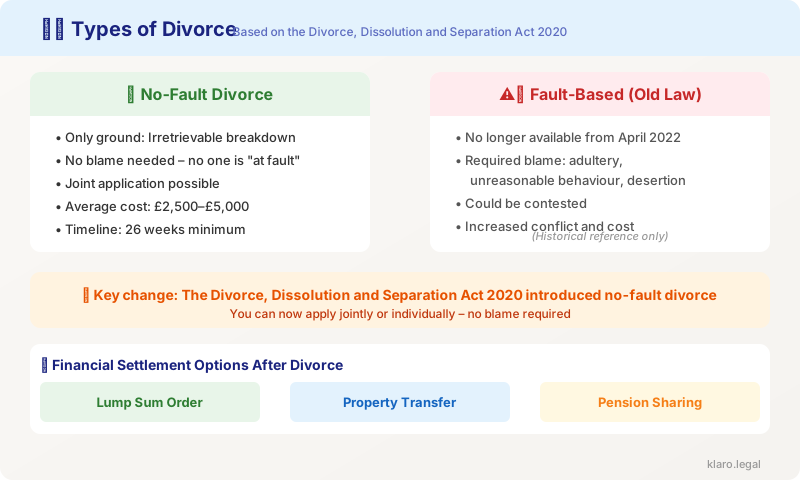
No-fault divorce: what changed in 2022
Before April 2022, you had to give a reason for divorcing, such as adultery or unreasonable behaviour. The Divorce, Dissolution and Separation Act 2020 removed this requirement for England and Wales. Now, one statement is enough: 'the marriage has broken down irretrievably.' Neither spouse has to be at fault.
Sole or joint application: what is the difference?
You can apply for divorce on your own (sole application) or together with your spouse (joint application). A sole application means you are the 'applicant' and your spouse is the 'respondent.' A joint application means both of you agree and apply together. Joint applications often feel less confrontational and can move more smoothly.
Scotland and Northern Ireland have different rules
This guide focuses on England and Wales. Scotland has its own divorce law, including a one-year separation period if both spouses agree, or two years if one spouse does not agree. Northern Ireland also has separate rules. If you live in Scotland or Northern Ireland, Citizens Advice Scotland or NI Direct are good starting points.
Can You Get Divorced? Eligibility Checklist
Before applying, you need to meet a few basic conditions. These are set out in the Divorce, Dissolution and Separation Act 2020 and apply to England and Wales.

You have been married for at least one year
You cannot apply for divorce within the first year of marriage. This applies even if the relationship broke down immediately. If you have been married for less than a year, you may be able to apply for a legal separation instead, and convert it to a divorce later.
England or Wales is your home
At least one spouse must be 'domiciled' in England or Wales, or have been 'habitually resident' there for at least a year before the application. In practice, this means you live there as your permanent home. If you are unsure whether England or Wales has jurisdiction, a solicitor or Citizens Advice can clarify.
Your marriage is legally recognised
The marriage must be legally valid and recognised under UK law. This includes marriages from overseas, provided they were legally performed in that country. It does not include informal or religious-only ceremonies that were never registered with the state.
The marriage has broken down irretrievably
This is the only legal ground for divorce in England and Wales. You do not need to explain why or provide evidence. You simply make a statement that the marriage has broken down irretrievably. The court accepts this at face value.
At least one spouse must be 'domiciled' in England or Wales, or have been 'habitually resident' there for at least a year before the application. In practice, this means you live there as your permanent home. If you are unsure whether England or Wales has jurisdiction, a solicitor or Citizens Advice can clarify. Your marriage is legally recognised
The 7 Stages of Divorce in the UK: Step-by-Step Timeline
The divorce process in England and Wales follows a clear sequence. Here are the seven stages, in order, with realistic timeframes for each.
Divorce Timeline: Weeks from Filing to Final Order
Source: HM Courts & Tribunals Service – Divorce Procedure Rules
klaro.legal
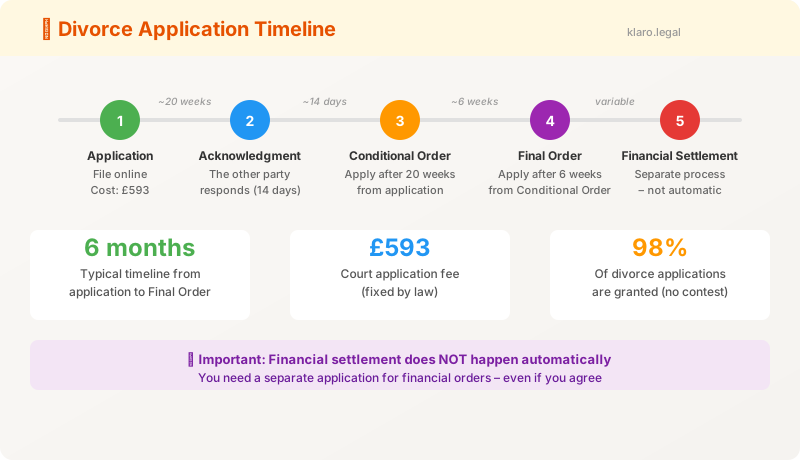
Stage 1: Submit the divorce application (Week 1)
You apply online via the gov.uk divorce service or by post using a paper form. You will need your original marriage certificate. If you cannot find it, you can order a copy from the General Register Office. A court fee is payable at this point.
Stage 2: Court issues the application (Weeks 1–4)
The court checks your application and, if everything is in order, issues it officially. In a sole application, the court then sends a copy to your spouse along with an Acknowledgement of Service (AOS) form. In a joint application, this step is simpler as both parties already agreed to proceed.
Stage 3: Spouse acknowledges receipt (Weeks 2–6)
In a sole application, your spouse has 14 days to complete the AOS form and return it to the court. This form confirms they received the application. It does not mean they must agree to the divorce, only that they received it. If there is no response, the process changes (see the section on unresponsive spouses below).
Stage 4: The 20-week reflection period begins (Weeks 6–26)
Once the application is issued, a mandatory 20-week waiting period starts. This is built into the law deliberately, to give couples time to reflect and, if relevant, negotiate finances and arrangements for children. You cannot skip or shorten this period. It runs from the date the application is issued, not from when the AOS is returned.
Stage 5: Apply for a Conditional Order (Week 20+)
After the 20-week period, you (or both of you, in a joint application) apply to the court for a Conditional Order. This used to be called a 'decree nisi.' It is the court's first formal confirmation that you are entitled to a divorce. The court reviews the paperwork and, if satisfied, grants the Conditional Order.
Stage 6: Wait 6 weeks and 1 day (Weeks 26–32)
After the Conditional Order is granted, another waiting period of 6 weeks and 1 day must pass before you can apply for the Final Order. This window also allows either party to raise a final objection, though this is rare. Many couples use this time to finalise financial agreements.
Stage 7: Apply for the Final Order (Week 26 minimum onwards)
The Final Order (previously called a 'decree absolute') legally ends the marriage. Once it is granted, you are officially divorced. The minimum total timeline from application to Final Order is around 26 weeks. In practice, delays in court processing, financial negotiations, or disputes can extend this to a year or more.
Key Legal Terms Decoded
Divorce paperwork is full of legal phrases that can feel confusing. Here is what the most common ones actually mean, in plain English.
Acknowledgement of Service (AOS)
A form your spouse returns to the court to confirm they received the divorce application. Returning it does not mean they agree to the divorce, it simply confirms receipt. In a joint application, this step works differently as both parties are already involved.
Conditional Order
The court's first official statement that your divorce can proceed. Previously called 'decree nisi.' It is not the end of the marriage, it is more like a green light. You still need to apply for the Final Order to be legally divorced.
Final Order
The document that officially ends your marriage. Previously called 'decree absolute.' Once this is granted, you are legally single and free to remarry. Keep a copy of this document, you may need it for things like updating a will or remarrying.
Consent Order
A legal document that records the financial agreement you and your spouse reach. Once approved by the court, it is legally binding on both parties. Without a consent order, a financial claim from an ex-spouse can still be made years later, even after the divorce is finalised.
Financial Remedy Order
A broader term for any court order dealing with money, property or pensions in a divorce. A consent order is one type. If you and your spouse cannot agree on finances, a judge can impose a financial remedy order after a court hearing.
How Finances, Property and Pensions Are Split
The divorce process itself and the financial settlement are two separate things. The court will grant your divorce regardless of whether finances are sorted. But leaving finances unresolved can have serious long-term consequences.
There is no automatic 50/50 split
The law does not require an equal division of assets. Under the Matrimonial Causes Act 1973, courts consider a range of factors: the length of the marriage, each person's financial contribution, future earning potential, and the needs of any children. In practice, a starting point of equal division is common in long marriages, but it is not guaranteed.
What happens to the family home
There are several options for the family home. One spouse may buy out the other's share and stay in the property. The property may be sold and the proceeds divided. Or, if children are involved, one spouse may remain in the home until the children reach a certain age, at which point the property is sold. The right arrangement depends on individual circumstances.
Pensions: the asset people often forget
Pensions built up during a marriage are considered a marital asset in England and Wales. Three main options exist: a pension sharing order (where part of one spouse's pension is transferred to the other), a pension attachment order (where a share of future pension payments goes to the ex-spouse), or offsetting (where the pension holder keeps their full pension but gives up other assets of equivalent value instead).
Why a consent order matters
If you and your spouse agree on how to divide your finances, that agreement should be recorded in a consent order and approved by the court. Without a court-approved order, either party can make new financial claims in the future, even years after the divorce. A consent order closes that door permanently.
Mediation as an alternative to court
If you cannot agree on finances, mediation is often a faster and less expensive alternative to a contested court hearing. A neutral mediator helps both parties reach an agreement. You are usually required to consider mediation before starting contested financial court proceedings. Mediation is not suitable in all situations, such as where there has been domestic abuse.
If you and your spouse agree on how to divide your finances, that agreement should be recorded in a consent order and approved by the court. Without a court-approved order, either party can make new financial claims in the future, even years after the divorce. A consent order closes that door permanently. Mediation as an alternative to court