


What Is a Payslip and Do You Legally Have to Get One?
A payslip is proof of what you earned and what was taken off before it reached your bank account. UK law gives most workers the right to receive one automatically, without asking.
Your legal right to one
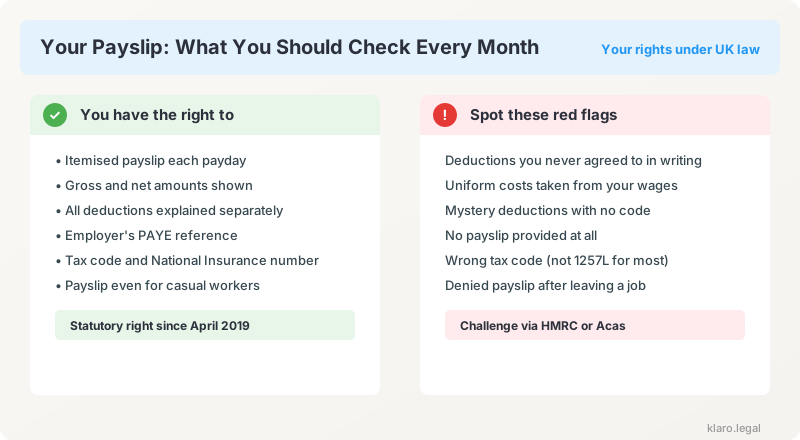
Under the Employment Rights Act 1996, employees and workers must receive an itemised payslip. Employers cannot withhold this, even if you're new or part-time.
Paper or digital, both count
Your payslip can arrive as a printed slip or through an online portal. Either format is legally valid as long as you can access and keep it.
Timing matters
Payslips must be provided on or before payday, not days later. If yours arrives late every month, that's worth noting for your records.
Keep them for a while
HMRC guidance suggests keeping payslip records for at least 22 months after the tax year ends. They're useful for mortgage applications, tax queries and benefit claims.
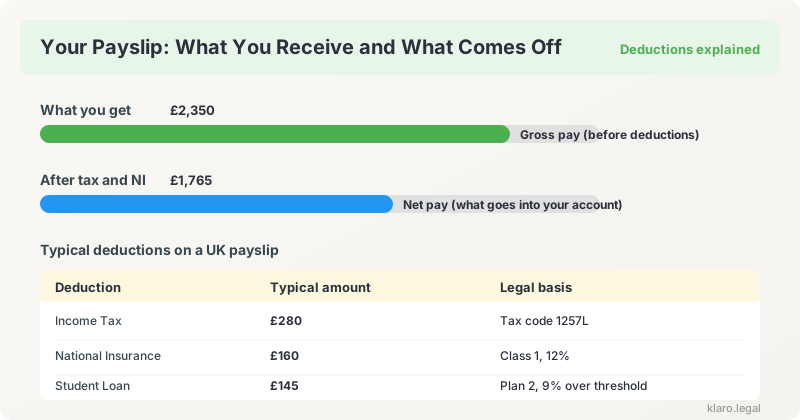
A payslip is a written or digital statement your employer must give you on or before payday. It shows your gross pay, all deductions like tax and National Insurance, and your final take-home (net) pay.
Payslip Example: Line-by-Line Breakdown
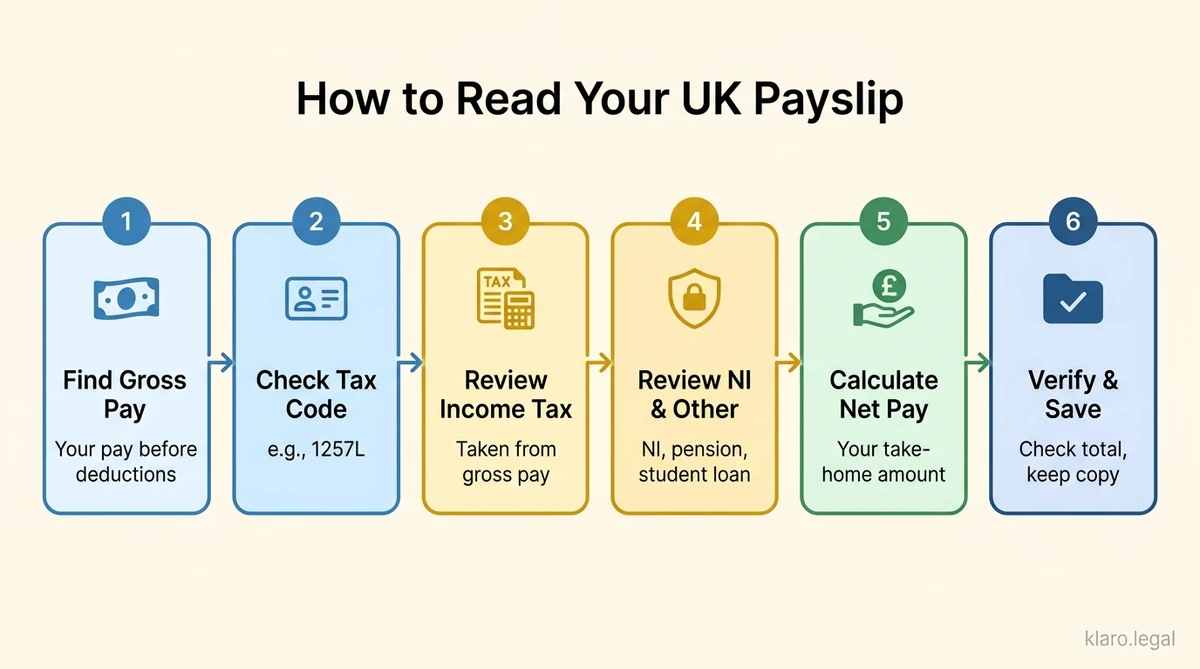
Every payslip follows a similar structure, even if the layout looks different between employers. Here's what each core section actually shows.
Gross pay
This is your total earnings before anything is taken off, your salary or hourly wage multiplied by hours worked, plus overtime or bonuses.
Tax code and deductions
Your tax code tells your employer how much Income Tax to deduct. It sits near your National Insurance number on most payslips.
Year-to-date (YTD) figures
YTD columns show your total earnings and deductions since the start of the tax year on 6 April. Comparing these month to month helps spot errors.
Net pay
This is what actually lands in your bank account, gross pay minus tax, National Insurance, pension and any other deductions.
Understanding Your Tax Code
Your tax code tells your employer how much of your pay is tax-free. Getting it wrong means you could pay too much or too little tax.
The standard code: 1257L
For the 2025/26 tax year, the standard Personal Allowance is £12,570, shown as tax code 1257L. This means you don't pay tax on the first £12,570 you earn.
Letters after the numbers
Letters like L, M, or K change how the code works. 'L' means you get the standard allowance; 'K' means deductions exceed your allowance, often due to unpaid tax from a previous year.
Emergency tax codes
Codes ending in W1, M1 or X are emergency codes, often used when you start a new job without a P45. These can mean paying more tax temporarily.
BR, D0 and NT codes
BR taxes all income at the basic rate, often used for a second job. D0 applies the higher rate to all income. NT means no tax is deducted at all.
Common Payslip Abbreviations & Codes
Payslips are full of shorthand that saves space but confuses readers. Here's what the most common terms actually mean.
BACS
Bankers' Automated Clearing Services, the system used to transfer your pay directly into your bank account.
YTD
Year-to-date, your total pay or deductions added up since the tax year started on 6 April.
EE NI / ER NI
EE NI is the National Insurance you (the employee) pay. ER NI is what your employer separately contributes, it doesn't come out of your pay.
Tax period
Which slice of the tax year this payslip covers. Monthly pay uses periods 1–12; weekly pay uses periods 1–52.
SL / SLC
Student loan deduction, money taken off automatically once your earnings pass the repayment threshold.
AVC
Additional Voluntary Contribution, extra money you've chosen to pay into your pension, on top of standard contributions.
How to Check If Your Payslip Is Correct: 5 Steps
Checking a payslip doesn't require an accounting degree. These five steps cover the areas most likely to contain an error.
1. Compare gross pay to your contract
Check your gross pay matches your agreed salary or hours worked, including any overtime, bonuses or commission owed.
2. Confirm your tax code is current
Check the code matches the one on your latest HMRC coding notice. An outdated code can mean incorrect tax deductions.
3. Check your National Insurance category
Most employees are category A. If yours looks different and you're unsure why, it's worth reviewing what determines your NI category.
4. Review pension contributions
Compare the pension percentage on your payslip to your workplace pension agreement to confirm the correct amount is being deducted.
5. Track year-to-date totals
Compare this month's YTD figures against last month's. The increase should match this month's individual figures exactly.
What to Do If Your Payslip Is Wrong
If numbers don't add up, there's a clear order of steps set out in law. What happens next depends on how your employer responds.
Raising it directly with your employer's payroll or HR team is the usual first step, since many errors are simple processing mistakes.
ACAS offers free, impartial advice on workplace pay disputes and can explain your options under employment law.
Under the Employment Rights Act 1996, a claim can be brought to an employment tribunal, generally within three months of the deduction.
HMRC handles tax code queries directly and can issue a corrected coding notice to your employer.
Payslips for Non-Standard Employment
Not everyone gets a simple, single-employer payslip. Zero-hours, umbrella and agency arrangements add extra lines worth understanding.
Zero-hours contracts
Your payslip will vary week to week based on hours actually worked. Gross pay and YTD totals are still required, just less predictable.
Umbrella company payslips
These often show an 'assignment rate' alongside your actual taxable pay, plus a separate margin the umbrella company keeps. Employer NI may appear as a visible deduction here, unlike standard payslips.
Agency workers
Your payslip usually comes from the agency, not the end client. It should still show gross pay, tax, NI and net pay exactly like any other employer.
Multiple jobs or second income
Only one job gets your full Personal Allowance, usually shown as 1257L. Other jobs often use a BR code, taxing all that income at the basic rate.
Payslip vs P60 vs P45: What's the Difference?
These three documents often get confused, but each serves a different purpose and covers a different time period.
When you get it
What it covers
Main use
Before You File Away Your Payslip
A quick final pass helps catch anything unusual before it's forgotten in a drawer or inbox.
Tax code matches HMRC notice
Confirms you're not overpaying or underpaying Income Tax.
Net pay matches your bank statement
The amount that hit your account should equal net pay exactly.
Pension deduction looks right
Check the percentage against your workplace pension scheme terms.
YTD figures increased logically
This month's totals should build correctly on last month's numbers.
Payslip saved or downloaded
Useful for mortgage applications, loans, or future tax queries.
Your Rights Around Payslips
UK employment law gives you specific protections when it comes to pay and payslips. These apply regardless of what your contract says.
Right to an itemised payslip
Employers must show gross pay, deductions, and net pay clearly. A vague or missing payslip doesn't meet legal requirements.
Protection from unlawful deductions
Deductions must be required by law, agreed in your contract, or authorised by you in writing. Unexplained deductions can be challenged.
Right to query without penalty
Asking about your payslip is a normal part of employment. Raising a genuine query about pay shouldn't lead to unfair treatment.